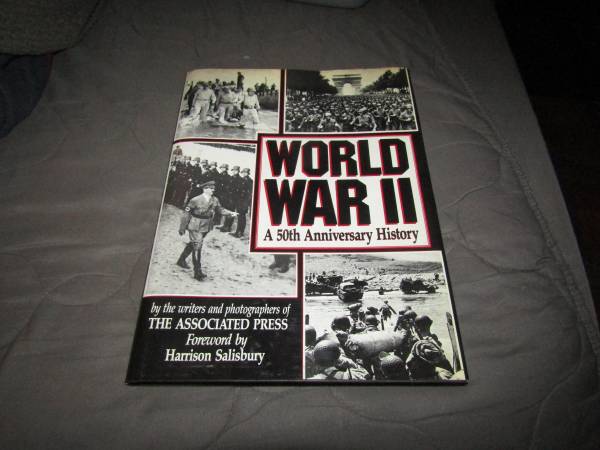
World War II: A 50th Anniversary History
Associated Press
Hardcover
ISBN 10: 0805010955 ISBN 13: 9780805010954
Publisher: Henry Holt & Co, 1989
Recreates, through hundreds of photographs, maps, and text, the war that shaped modern history, depicting the various battles--victories and defeats--and the people who were affected by them
The 50th anniversary has sparked the publication of several new histories of World War II. This one has particular interest because key personalities have been detailed, giving their motivations and strategies and stressing their importance to the war effort. The realities of the war and a humanistic view of its participants are effectively and concisely conveyed, with specific facets highlighted in sidebars. The numerous black-and-white photographs are well chosen and add interest to the text. An index is provided, but it is not comprehensive, a minor flaw in an otherwise excellent history. Recommended for researchers and those interested in the subject.
Here is the full extracted text from the three images you uploaded:
Most historians zero in on 1939 as the actual beginning of World War II, the most destructive conflict in modern human history. It was then, fifty years ago, that Hitler's forces invaded and blitzed through Poland, precipitating a declaration of war by Britain and France on Germany.
Inexorably, virtually the entire world became enmeshed; few escaped its consequences.
America was aware in 1939 that it would be drawn into the conflict. President Roosevelt expressed the feeling; "Let no one imagine that America will escape, that it may expect mercy, that this Western Hemisphere will not be attacked."
But at first, the United States sat on the sidelines, a concerned spectator temporarily satisfied in building an "arsenal of democracy" for its allies. With the Japanese attack on Pearl Harbor near the end of 1941 came the inevitable American commitment to the war. More than 16 million men and women served in the armed forces. When it was over, over there and here, the tragic count was nearly 300,000 U.S. battle deaths, almost 115,000 other deaths, more than 670,000 wounded—totals three times greater than those of World War I.
Nearly two hundred Associated Press correspondents covered the war; some lost their lives, or were injured or shattered by exposure and illness.
Through many of their words and pictures, this book recalls and commemorates the war that changed the shape and future of the world.