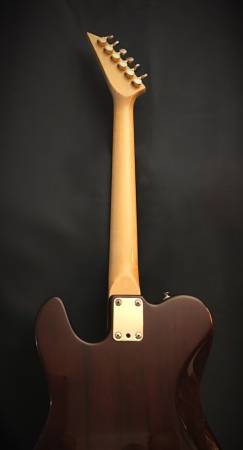
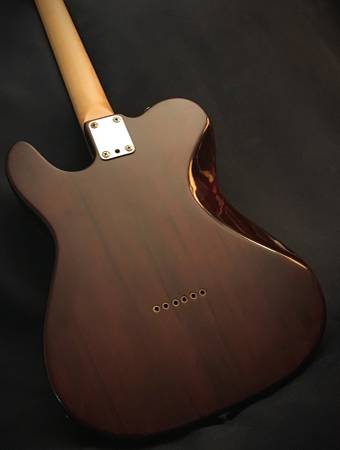
=> Offering a great sounding ‘MCI Telecaster’ make-over with low low action! The 1983-85 USA-Japan ‘R/T 2000’ guitars started off with beautifully carved mahogany and maple bodies - likely from Dyna Gakki Japan. MCI Intertek - known for their ‘steel guitars’ at the time - was branching out to build ‘solid guitars’ at their factory shop in Dallas.
* * Correction re the effects switches: the volume pull pot up is a ‘both coils on’ in series switch - while the red toggle seems to be a ‘middle on’ switch. * *
About the guitar:
This MCI Tele is far from stock (and definitely not the original guitar that shipped in the mid 1980s!). That said - Prince was seen playing one of them at some point (for what that may be worth)!
The rebuild:
Starting with the original ‘Les Paul inspired’ maple-mahogany body and neck - this ‘R/T 2000’ was brought to Tele-nerd perfection by famed SF Bay Area luthier, Al Milburn and guitarist-owner, Felix Bannon! Purchased new (or ‘as new’?) from Bananas Music, in late 1980s San Rafael, Felix re-fretted it himself with medium-jumbo wire (as is his habit) - but looked into further improvements for the pickups… SF Bay Area luthier Al Milburn was asked to install three new Duncan Hotrails - and pretty much re-did all of the wiring while adding a five way and other circuit mods... In multiple steps - a ‘premium version’ of MCI’s original guitar was created! One of many rarities in Felix’ amazing collection. Only being liquidated to pay for essential van repairs! That said - it is way past time for this one to be seen and heard regularly. It is a monster tone machine, with playability to match.
Specs, and custom upgrades from stock:
* * This is to apologize that some of the mod explanations were wrong in my earlier version of the ad! * *
A trifecta of Seymour Duncan Hot Rails (double coil) ‘stacks’ have replaced the original low rent ‘Saxons’ - and they offer plenty of pop and sizzle! Al Milburn added several popular circuit switches per Felix’ consultation… The ‘five way’ selector works like a Strat - but with slightly different out of phase tones from the Duncan double coils... A red mini-toggle was added for middle pickup on! Switch upwards and the middle is ‘on’. This primarily affects the 5 way positions where the middle is normally ‘off’.
In addition - the volume knob can be pulled up to utilize both coils on in series in each setting! This acts like an onboard ‘fat’ switch, and tends to push more gain as well… So - volume knob down? The Tele’s default - and it starts you out in ‘parallel’… Closer to a ‘traditional Tele’ palette. There’s a lot to work with tonally on this instrument.
Given its mahogany body and maple cap - the guitar does sustain like a Les Paul! And with the electronics upgrades, there is no shortage of great tonal options! Twang, cut, saturation, crispy Strat sounds… It’s almost a ‘one guitar to the gig’ instrument now. Plenty of grit, growl, and jangle on tap! ‘Pushed’ tones are easily had from the medium output Rails… Vintage Jimmy Page is definitely in there…
Condition and playability:
Action is super-naturally low, with Felix’ custom medium jumbo fret job holding up! No issues… Fyi - he also sanded the ‘Fender style’ fretboard curve down a little bit, for bend-a-bility. Now, he says, the ratio is “closer to a 10.5 or maybe 11” (inches). And definitely a compound (i.e. variable) flattened curve!
Having been mostly a ‘collectible backup’ in more recent years - the cumulative wear on this guy is very moderate! And player action (as mentioned ) is at a high standard indeed! A medium - not super skinny or thick ‘C’ profile (25.5” scale) Fender-ish neck makes chording comfortable - while the one and 10/16” nut supports a string span that tapers outwards to about 2.5” (at the bridge)… Weight is somewhat substantial - 8.5 pounds - but given the ‘Les Paul-like’ sustain (‘for days’!) - actually pretty moderate.
Extras:
There’s a comfy leather strap; a surprisingly light Squire hardcase - and a fresh set of strings will be waiting for you inside.
The takeaway:
This one was a tough call for the owner of the axe! The mods and uncommon woodwork make it a quite ‘special’ guitar. Teles are usually ash or alder - with very ‘musical’ but typically mid to upper range palettes... This one has a good bit of that traditional Tele sound - but definitely adds some more scooped ‘Strat tones’ - or - ‘saturation’ - depending on settings!
A real player… Not to be missed!
=> Please use the CL mail relay or CL chat to contact me, and put ‘MCI Telecaster’, or similar on the subject line. Am mobile, and able to do ‘remote demos’… Can do ‘meet ups’ in any safe and appropriate Bay Area location.
I’ll respond to CL chat intermittently…
Thanks for checking out the ad!
* * * MCI Intertek history * * *
Read for personal interest if you like! Its a good story, if you’re a long time player or collector!
The ‘MCI story’ follows music industry changes from Nashville to Dyna and Fujigen Gakki (Omachi) Japan! Also from Dallas - and eventually to Fullerton and Corona! Both Intertek’s CEO-founder and its lead designer wound up ‘in house’ at Fender! But not until MCI had been acquired by ‘Fred Gretsch III’ (circa 1985-7)! Yes, it’s apparently a small world out there folks! And meanwhile - Dyna Gakki’s sister shop - ‘Fujigen Gakki’ became ‘Fender Japan’ (just three years after this model series showed up in US music shops!)! It took quite a bit of web research to pull all of these disparate facts together - but timing tells the story! MCI were the pedal steel option of choice all over Nashville at the time... So marketing Tele and Strat style guitars seemed like a no-lose proposition to John Birkhead and Gene Fielding!
Who are ‘MCI Intertek’? And - where did their guitars come from (skip this part if you know!)!?
Founded in the late 1970s by John Birkhead - ‘MCI’ was a Dallas located small shop maker of pedal steel guitars. Birkhead also hired two of the top pedal steel players in country to build and consult! Both Buddy Emmons and Buddy Carter worked at Intertek when they weren’t touring! But the solid guitar line came later - between 1983-85 - during the rise of ‘young country’ in Nashville!
The Fender inspired instruments are rare now - and information is sparse... But they appear to have been collaborations between MCI Intertek and Daion (Dyna Gakki) of Japan. The partnership of Birkhead with his design engineer Gene Fielding was celebrated in the steel guitar world - and for good reason. Their stand mounted steel guitars were well made, and became dominant choices among professionals during those times. Both men were later employed by Fender (where Fielding became a minor celebrity in guitar design!).
The idea to market Teles and Strats drew heavily from MCI contacts in the expanding Nashville scene... The three pickup ‘Nashville Tele’ was one of the ‘new’ solid body guitar designs! These were likely suggested by Birkhead but designed by Fielding. Birkhead had formerly modded Gibson and Standel hollow bodies to build ‘Guitorgans’! John Birkhead’s entrepreneurial instincts likely led them to believe that Intertek could sell ‘solid body guitars’!
There are so many stories of small shop builders who’s products failed to sell! But with two of America’s (or the world’s) pre-eminent pedal steel players on board - the MCI ‘console guitars’ at least did sell! Birkhead had left his Guitorgan proto-synth business in Waco to start MCI Intertek with Fielding circa 1978… They had quickly become pedal steel moguls in part, by bringing virtuosos, Buddy Emmons and Buddy Carter into the company. So both men’s careers as studio musicians made advertising nearly irrelevant. They inadvertently helped build a network of Nashville and Texas industry contacts.
As USA distributors for Daion, Japan - MCI also had a manufacturing partner to make the wooden bodies and necks for their new ‘solid body project’! The bits of history on-line speak of ’Saxon’ brand pickups (maybe ‘Maxon’?) - and suggest that overseas fabricated components were likely ‘assembled in’ Dallas. Thus the opportunistic ‘built in America’ assertiond coexisting with contrary claims about being ‘built in Japan’! More than likely, both were true.
But anyone who’s ever tried to start a new product line knows that procurement and distribution can be ’the straws that break the camel’s back!’ So it should come as no surprise that the MCI ‘solid body guitar project’ had hit a sour note by 1985... Or - that Fred Gretsch the third would almost magically show up around 1986-87 to buy out MCI Intertek entirely!
As for Gene Fielding? Fender put him to work as an in-house design executive! He stayed on there until his retirement - becoming a major figure of influence within that venerable company! And the restless John Birkhead!? He also got hired by Fender… For that matter - Fred Gretsch as well - although his Gretsch role did not actually make him their employee, per se. But Birkhead will always be well thought after in the pedal community for giving two of its most famous players hands on roles in Steel Guitar design and construction.
So their story has a happy ending! Lots of anecdotal connections with musicians and the Nashville sound - as well as Corona.