NAME: Beat Bop
ARTIST: Jean-Michel Basquiat (1960–1988)
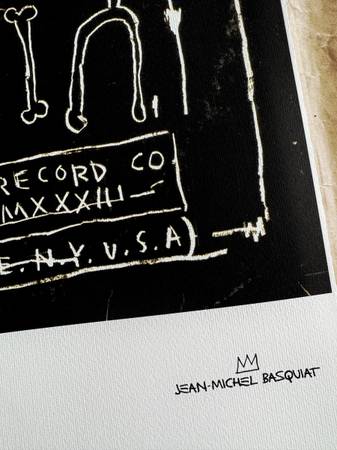
SIGNATURE: Facsimile Artist Signature
CERTIFICATE: Certificate of Authenticity (COA) Included
DIMENSION: 70 × 50 cm (UNFRAMED)
FRAMED SIZE: 80 × 60 cm
PRESENTATION: Professionally Framed, Ready to Display
ART CONCEPT
Beat Bop – When Street Art Became the Voice of Hip-Hop
There was a time when the streets of New York became one of the most exciting creative spaces in the world.
During the early 1980s, graffiti, underground music, experimental art, and emerging Hip-Hop culture began to transform the artistic identity of the city.
Jean-Michel Basquiat stood at the centre of this extraordinary cultural movement.
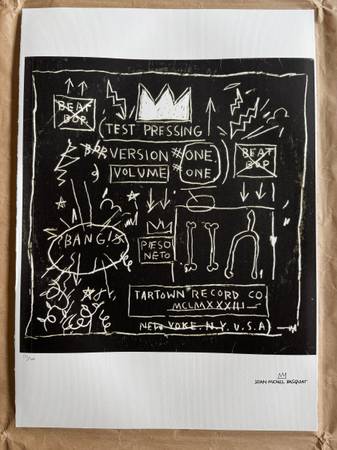
Created in 1983, Beat Bop represents a remarkable intersection of visual art and music — a moment when Basquiat's unmistakable artistic language became part of the emerging history of Hip-Hop.
Originally designed as the cover for a record featuring underground rappers Rammellzee and K-Rob, the artwork captures the raw energy, independence, and experimental spirit of New York's downtown creative scene.
At first glance, the composition resembles a chaotic collection of handwritten words, mysterious symbols, and spontaneous drawings.
Against a powerful black background, white lines form a dense network of crowns, arrows, lightning bolts, anatomical references, and fragmented text.
The words BEAT BOP, TEST PRESSING, VERSION ONE, and TARTOWN RECORD CO. appear throughout the composition, connecting the image directly to the world of recorded music.
At the centre, Basquiat's iconic three-pointed crown rises above the surrounding visual disorder.
The crown was one of the artist's most recognizable symbols, frequently associated with power, identity, recognition, and the celebration of overlooked cultural figures.
Here, it seems to preside over a world of rhythm, language, and creative rebellion.
Other elements appear almost like fragments of an underground visual code.
Arrows point in unexpected directions.
Words are crossed out, repeated, or enclosed within rough geometric shapes.
Abstract anatomical forms emerge beside energetic marks that resemble electrical signals.
Nothing appears carefully arranged according to traditional artistic rules.
Yet the composition possesses an extraordinary internal rhythm.
Like an improvised musical performance, each symbol seems to respond to another, creating a continuous movement across the surface.
The striking contrast between black and white gives the artwork an immediacy reminiscent of chalk drawings, graffiti-covered walls, and handwritten messages left throughout the city.
Its visual language feels urgent, spontaneous, and unapologetically unconventional.
For Basquiat, words were never simply explanations.
They were visual elements in their own right — capable of carrying multiple meanings through repetition, alteration, and deliberate interruption.
Even the crossed-out words demand attention.
Rather than disappearing, they become more visible, inviting the viewer to question what has been concealed and why.
This tension between language and image is one of the defining characteristics of Basquiat's artistic practice.
But Beat Bop is more than an exploration of symbols.
It is also a remarkable document of a cultural moment.
During the early 1980s, Hip-Hop was developing into a powerful form of artistic expression, shaped by musicians, graffiti artists, DJs, and performers who challenged conventional boundaries.
Basquiat recognized the creative significance of this movement and became directly involved in its development.
By producing the Beat Bop recording and designing its cover, he helped create a work in which music and visual art became inseparable.
The record's experimental sound and the artwork's unpredictable composition share a common spirit.
Both celebrate improvisation, individuality, and the freedom to create outside established conventions.
What makes this design particularly compelling is its refusal to separate fine art from popular culture.
Basquiat transforms the visual language of the street into something worthy of artistic attention, while allowing the energy of underground music to become part of his creative vocabulary.
The result is an image that belongs simultaneously to the histories of contemporary art, graphic design, and Hip-Hop.
Today, Beat Bop remains a powerful reminder of a time when extraordinary artistic ideas emerged from the collision of different creative worlds.
Its black-and-white composition possesses a striking graphic clarity, making it especially compelling within contemporary, minimalist, industrial, and eclectic interiors.
When displayed in a living space, the artwork becomes more than a decorative image.
It introduces the rebellious spirit of 1980s New York, the visual energy of street culture, and the unmistakable artistic identity of Jean-Michel Basquiat.
More importantly, it invites the viewer to look beyond the apparent disorder and discover the remarkable cultural history hidden within every word and symbol.
Because sometimes, the most influential artistic revolutions do not begin inside museums.
They begin in the streets, where music, imagination, and freedom come together to create something entirely new.
ABOUT THE ARTIST
Jean-Michel Basquiat (1960–1988) was an American artist who became one of the most influential figures in contemporary art.
Emerging from New York City's vibrant cultural landscape during the late 1970s and early 1980s, Basquiat developed a distinctive artistic language combining expressive figures, symbols, words, and references to history, identity, music, and popular culture.
His work challenged conventional artistic boundaries and established him as a defining voice of his generation.
Today, Basquiat's artistic legacy continues to inspire audiences around the world through its emotional intensity, originality, and uncompromising creative spirit.
ARTWORK & PURCHASE DETAILS:
Rare authorized art print with a facsimile artist signature.
Certificate of Authenticity (COA) included.
Professionally framed and ready to display.
Local delivery of the artwork may be arranged.
Please message us with your location for details.
We also have a larger collection of 19th-century French and European antique lithographs available.
Message us to request our Antique Lithograph Catalogue for additional works, sizes and subjects.
Ideal for contemporary living rooms, modern interiors, art collectors, creative spaces, offices.