We are not experts but this is an AI-assisted description.
• Folk Art History
Acoustic Sound Engine
The Voice: Partially alive, 2 of the 3 strings produce a deep guttural resonant sound when plucked.
The Box: The core sound engine is beautifully intact. Two of the three strings hold tension and project an earthy low-end tone despite the instrument's age.
Handcrafted Details
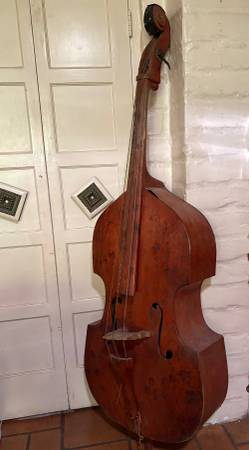
The Frame: Gamba-style body. Rare, dedicated native 3-string design (never converted from a 4-string frame). 19th-century regional artisan craftsmanship with beautiful, man-made soul.
Tonewoods: Tight-grained spruce top plate with dense, fine-grained regional hardwood back and ribs coated in a rich, patinated red-amber varnish
.
Hardware: Native bench-made setup with a matching set of three rustic, hand-filed iron worm-gear tuning machines.
Folk Elements: Strung with nylon monofilament cords protected by hand-wound copper/silver wire wraps. The top scroll features an authentic vintage, stud-secured heavy rubber protective bumper—used historically to protect the soft wood during street processions.
Provenance: Antigua Guatemala, historic UNESCO World Heritage city founded 1524.
Significance: During the Spanish colonial and post-colonial eras, Antigua was a massive religious hub filled with cathedrals and convents. 3-string double basses were widely used across church orchestras because their deep lower register beautifully carried through large stone sanctuaries. Last photo shows peek through keyhole.
Folk Adaptation: An earthquake caused the colonial capital to move and many classical instruments filtered into folk ensembles (cofradías).
Size: Standard 3/4 Size Upright
Height: 72" / 183 cm
Longest String Length: 51" / 129.5 cm
Upper Bout: 19" / 48.3 cm
Lower Bout: 23" / 58.4 cm
Pegbox Widest: 2 5/8" / 6.7 cm
Condition Notes: Showcases expected historical seam separations on the lower bouts. Has some chips in the surface finish. Fully stable for immediate premier interior display. AI says instrument is repairable but consult a professional luthier if you intend to repair or restore. We offer no guarantees. Sold as-is with all inspection responsibility assumed at point of physical pickup.
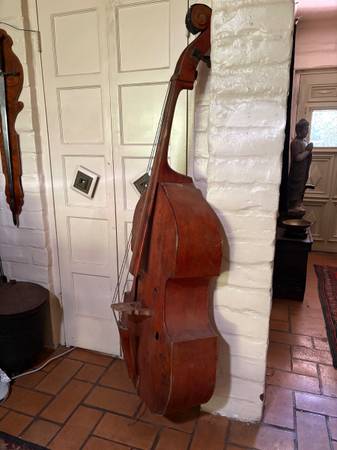
Antique or vintage acoustic swell back double bass with a dark reddish-brown finish, sloping shoulders, and a gamba-style body shape, $15,000
This item was found in a shop of antiquities in Antigua, a Unesco heritage site with cobblestone streets that was founded in the 1520s in Latin America. Because this was found in a Spanish colonial hub, it is possible that this bass was imported from a European trade center during the 19th century to supply churches or early classical ensembles in the region, or it could be a rare early local commission patterned after European designs. It is a unique deep color with reddish tones.
Historically, 3 String Basses 4 String Basses. The switch happened around the 1800s. This antique acoustic swell back double bass with a dark reddish-brown finish, sloping shoulders, and a gamba-style body shape
The red tone color of the wood is magnificent along with the original hardware. Close-up photos shows rustic, hand-modified, and early industrial hardware that strongly suggests this double bass is a 19th-century folk instrument (likely circa 1840–1890), potentially of European origin (such as Germany, Bohemia, or Eastern Europe) or an early American folk creation.
Has a rubber strap wrapped around the scrolled top that is fastened with studs (that was probably added later in life of the instrument). Overall has a hand carved, primitive, rustic folksy look.
Ornamental Decorative piece, not currently in playable condition except that 2 of the 3 strings make sound. Even though it has flaws, the sound made by 2 of the 3 strings is loud, deep and resonant. There appears to be some copper or silver strands as part of the strings wrapped around in the pegboard.
Features a carved wood body, traditional f-holes, a wooden bridge, and a scroll at the headstock and only 3 strings compared to modern 4 strings.
An antique double bass with three strings instead of four reflects a standard historical design from the 18th and 19th centuries before four-string setups became the modern norm.
History of the 3-String Double BassTuning variations: In the 18th and 19th centuries, three-string basses were common across different regions, particularly in Italy and England, where they were typically tuned in fourths as A, D, and G, or in other regional tunings.
Message for link to short video showcasing a rare, historic 3-string upright bass to see how these vintage instruments look and sound in comparison to modern 4-string models:
The antique has lived through multiple climates on multiple continents and shows visible signs of age, wear and distress including slender cracks near the holes and separation. Has water spots that can be cleaned or leave as is for patina. Sold as is.
tags: ethnic arte fina antique musical instrument tags: Rare 3 String Instrument ethnic folk antique musical instrument Deep Resonant Voice 72” Tall Remarkably Alive Sound Box