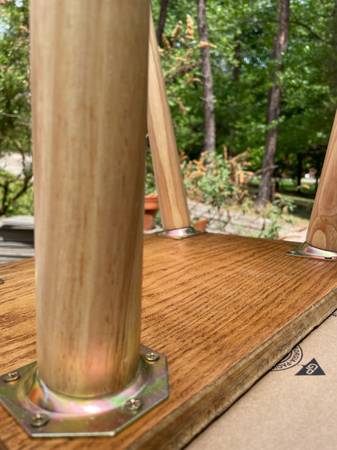
You won’t find another one of these because they were just made. Rare Neese crates that were used years ago for delivery and returned to the factory have been repurposed into side tables.
These are rare because of the vintage, the legible lettering, the top and crate are a matching set and the top sits on a groove. Top is removable to store your keepsakes or items you don’t want your family to find ;-)
Base is attached by Velcro as to not penetrate the original wood bottom.
The legs are 16” and new. Cleaned and has a fresh coat of satin polyurethane with the original blonde wood
I have two of theses
Era Delivery Method
1917 James Theodore ("Mr. Thede") Neese sold hand-ground sausage from a covered wagon.
1925 The company upgraded to a Dodge screen-sided truck for daily deliveries in Greensboro and High Point.
Mid-20th Century
The iconic wooden crates were the standard for store deliveries as the company expanded into Charlotte and beyond.
Early Delivery: Before the widespread use of refrigerated trucks and plastic bins, Neese’s delivered their signature "brick" sausage to local markets in sturdy wooden boxes.
Design and Durability: The crates were built to withstand the weight of numerous one-pound bricks of sausage and liver pudding. They often featured the company’s logo, which includes a recognizable plump hog silhouette.
Dimensions: A standard crate typically measures approximately 15" x 11.5" x 5". They were designed to hold the company's signature rectangular one-pound blocks of sausage, a shape famously chosen by the founder so the product wouldn't "roll out of the truck."
• Historical Context: These crates were likely in heavy use from the 1920s through the mid-20th century. By 1925, the company had transitioned to using screen-sided trucks for daily deliveries in Greensboro and High Point, and these durable wooden boxes were essential for transporting fresh meat safely before plastic crates became the industry standard.