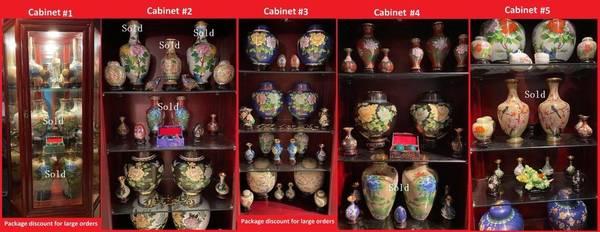
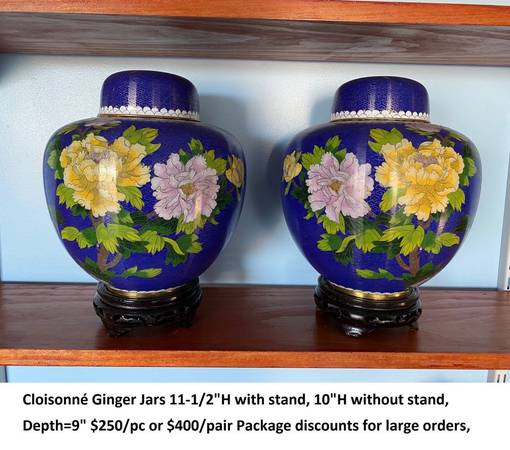
These items were hand made in Beijing China during the early period of the PRC exported to Hong Kong and were imported into the United States in 1978. This kind of art work started in ancient Egypt (King Tut’s mask was made of gold and enamel - Cloisonné is basically enamel on copper) the early missionaries introduced the enamel art to China during the reign of the Yuan Dynasty; the art was perfected in the Ming Dynasty JingTai (景泰)emperor (1449–57). The Chinese name for cloisonné is called Jǐngtàilán (景泰藍)- JingTai Blue (blue was a dominant color at that time). Cloisonné is the technique of creating designs on metal vessels with colored-glass paste (silicon oxides) placed within enclosures made of copper or bronze wires, which have been bent or hammered into the desired pattern. Known as cloisons (French for “partitions”), the enclosures generally are soldered onto the metal body (usually brass or bronze). The glass paste, or enamel, is colored with metallic oxides and filled into the contained areas of the design. The vessel is fired at about 800°C. Enamels commonly shrink after firing, and the process is repeated several times to fill in the designs. Once this process is complete, the surface of the vessel is polished and rubbed until the edges of the cloisons are visible. The metal areas are then gold plated in an acid-gold solution bath; the electroplating process will take place and deposit a layer of gold on the exposed metal areas – usually the edges, in the interior, at the mouth area and on the base. The layer of gold prevented the oxidation of the brass parts. This kind of cloisonné work is now almost a lost art in China – as the younger generation no longer interested in doing this kind of work. Nowadays only a handful of craftsmen in Beijing still practice this craft and most of the products are procured by the central government and use them as gifts to foreign heads of states (国礼).