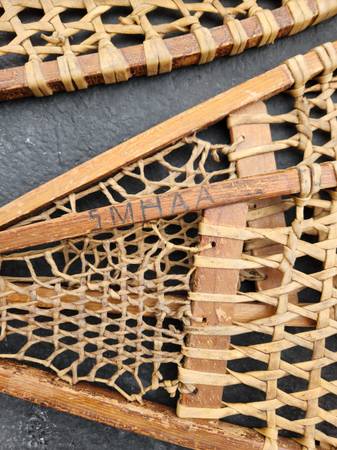
Penobscot official rawhide snowshoes refer to both traditional Native American winter footwear and mid-20th-century vintage commercial sporting gear modeled after those historic designs. Authentic historic versions are highly prized, museum-quality examples of Wabanaki craftsmanship. Commercial versions like the mid-century "Penobscot Special" are highly sought after by collectors for rustic cabin decor.
2 pairs of snowshoes - sold as a set of 4 or by the pair. $175 for one pair. $325 for all 4 (better deal)
The "Penobscot Special": These were manufactured commercially in the early-to-mid 1900s by makers like J.A. Osgood in Milford, Maine. They feature traditional white ash frames, heavy-duty rawhide webbing, and thick leather foot harnesses.
Historical Significance and Craftsmanship
• Cultural Origins: Traditional Penobscot snowshoes were meticulously hand-built by the Penobscot Nation and other Wabanaki tribes of the Eastern Woodlands.
• Design Features: They are historically famous for their intricate, ornate "trefoil" babiche work (fine, untanned animal hide lacing) and double selvage cords in the center.
• Materials: Indigenous artisans split and steam-bent native white ash or birch to build the frames, lacing them tightly with raw moose, deer, or caribou hide.
• Famous Legacy: Their superior design caught the attention of early American figures. Henry David Thoreau famously purchased a custom pair from a Penobscot craftsman in 1853 to navigate the Maine wilderness. Historic pairs are preserved today in institutions like the Abbe Museum and the Maine State Museum.