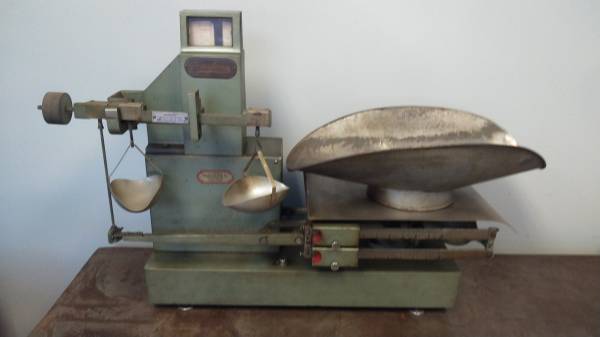
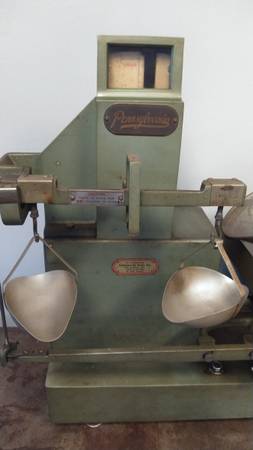
Commercial Piece/Parts Counting Ratio Scale - Pennsylvania Scale Company
$100 or best offer
A Parts Counting Scale is a specialized weighing instrument used to determine the quantity of small, identical parts (or pieces) in a batch. Here’s how this one works:
1) Place the parts to count in the counting bin on the right. They must all be closely identical in weight, like the same screws, marbles, or M&M candies.
2) Take one or more parts from the bin and place them in the small 99:1 tray until the over-under indicator is close to center, but not over. If over with a single part in the tray, you are counting less than 100 pieces, so skip to next step.
3) Take one or more parts from the bin and place them in the small 9:1 tray until the over-under indicator is very close to center, but not over.
4) Remove parts from the bin until the over-under indicator is exactly in the center. You shouldn't need to remove more than 9 parts to get it to balance exactly.
5) Count the number of parts in the 99:1 tray, and multiply by 100.
Count the number of parts in the 9:1 tray, and multiply by 10.
Add these two numbers. This is the total number of parts being counted by the machine Important! This count includes the parts in the 99:1 and 9:1 trays.
Note: You can always add any parts you counted by hand (i.e. removed from the bin to get it to balance) to the total calculated in step 5. For example if you had 5 parts in 99:1, 6 parts in 9:1 and had to remove 3 parts from the bin to get the under-over indicator to balance in the center, you would have 5 x 100 + 6 X 10 + 3 = 563 parts in total.
These scales are essential in industries where precision matters, as they streamline inventory management, reduce manual counting hours, and prevent costly mistakes.