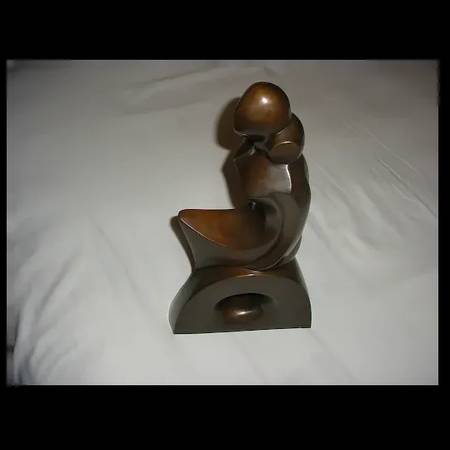
AVAILABLE FOR PURCHASE IS A RARE 16” SIGNED AND DATED 1957 MODERN BRONZE SCULPTURE CREATED BY CUBAN ARTIST JOSÉ FLORENCIO GELABERT PÉREZ (1904-1995) THAT DISPLAYS AN ABSTRACT FIGURATIVE SEATED WOMAN RENDERED IN AN “ORGANIC CUBISM” STYLE WITH REDUCTIVE FEATURES EMPHASIZING SHAPES, CURVES, LINES, CONTOURS, VOLUMES, AND A STRONG SENSE OF FORMAL PURITY!
Dimensions: This original vintage Florencio Gelabert bronze sculpture measures approximately sixteen inches (16”) in height, eight and three quarters inches (8 ¾”) in width at its widest point along the base, by six and one half inches (6 ½”) in depth at its deepest point along the base.
Signature: Signed and dated within the bronze along the bottom right edge “F. Gelabert 1957”
Please Note: This bronze sculpture by Florencio Gelabert is most likely unique with only one having been created. The artist’s signature does not include an edition number.
Condition: Very good toward excellent and clean condition with some minor rubbing and small markings to the surface patina here and there. But overall, still a true rare beauty!
Price: $2500.00 (firm and cash only)
To view the Cuban artist José Florencio Gelabert Pérez (1904-1995) rare 16” signed & dated 1957 modern bronze sculpture available for purchase here, please send an email to John to arrange a time that is convenient for you. Thank you.
Please Note: This is a cash only, local pick-up transaction in the town of Cave Creek just north of Scottsdale. You will need your own transportation. This Cuban artist José Florencio Gelabert Pérez (1904-1995) rare 16” signed & dated 1957 modern bronze sculpture is safely stored in a private home and is easily accessible.
Lastly, this item is available as long as this advertisement is up and running. There is no need to send text or email messages asking if it is still available.
(the following information is courtesy the website for Wikipedia)
José Florencio Gelabert Pérez ( Caibarién, February 23, 1904 - Havana , August 30, 1995) was a Cuban musician, sculptor, cartoonist, and teacher.
José Florencio Gelabert Pérez was born in the town of Caibarién, Las Villas, in Cuba, on February 23, 1904. From a humble family, he worked as a foundry apprentice in his adolescence. Interested in music, Gelabert joins Caibarién's band. Having received a scholarship to study at the San Alejandro National Academy of Fine Arts, he moved to Havana and graduated in 1934.
Without abandoning music, he was linked to important Cuban musicians of the time, such as Amadeo Roldán and Alejandro García Caturla. He held a professorship at the School of Fine Arts. Around 1938, he decided to dedicate himself completely to sculpture, an art that he would cultivate for the rest of his life.
Around that time, he went on tour through Europe, visiting Paris, Naples, Rome, Florence, Venice, and Belgium. In Paris, he meets Wilfredo Lam and meets Antoine Bourdelle 's widow, being able to have access to her studio. He returned to Cuba to study pedagogy and later went to Mexico, a country where he held one of his first personal exhibitions, at the Palace of Fine Arts.
Upon returning to Cuba again, he created numerous sculptures in public places, such as the monument to General Quintín Bandera and the decorations of the Habana Riviera Hotel, the Sea Horse, the Nymph, the Shark and another bronze sculpture group, in front of the entrance from the cabaret of said hotel. He also has the allegorical fountain for transportation that is on the side of the Bus Terminal, that of the Atlantic Hotel and the mural of the Santa Catalina ice cream parlor.
After the triumph of the Cuban Revolution in 1959, Gelabert directed the San Alejandro National Academy of Fine Arts [ 2 ] until 1963 . Afterwards, he goes to work at the Ministry of Construction. He sculpted a Giant Crab at the entrance to his hometown. He received numerous awards and honors. Several of his works are in the permanent collection of the National Museum of Fine Arts. Likewise, he built the Pantheon of Veterans of the War of Independence in the Columbus Cemetery in Havana.
Florencio Gelabert died in Havana , on August 30 , 1995 , at 91 years of age.
(the following information is courtesy the website for Desmemoriados)
Florencio: sculpture and music in the Gelabert dynasty
By Rosa Marquetti Torres
January 6, 2022
Day-to-day emergencies do not leave too much time for curiosity. I have the impression that many who approach the once lavish Havana Riviera hotel in Havana do not know who was the author of the excellent sculpture of the Nymph and the Seahorse, which flanks the short access bridge and identifies its outer area. If we manage to enter, we may not notice another sculpture – called Rhythms by its author – almost as large as that one, of incredible cleanliness in its lines, which suggest a singular movement, and in which the figures seem to come alive as dancers of a music that only they seem to hear. Like these large sculptures, other smaller sculptural groups, located in the same enclave suggesting the movement that seems impossible to ask for stone figures, correspond to the notable Cuban sculptor Florencio Gelabert (Caibarién, February 23, 1904 – Havana, August 30, 1995).
I imagine that when Gelabert received the commission from the team led by the American architect Irving Feldman, the main challenges that the artist had to face to create a sculpture that would be located on the seashore, were coherent beauty, sense of identity, but above all durability. Sixty-four years later, The Nymph and the Seahorse remain unscathed by the onslaught of saltpeter in the immediacy of the sea, the fury of hurricanes and the no less ferocious ravages of laziness. Direct concrete clad with concrete was the material chosen by the sculptor to ensure its permanence. Inside the hotel facility, Ritmos is a fabulous sculptural ensemble, made in bronze in four or five parts, which presides over the lobby or lobby, and where the sculptor reiterates the evocation of dance and his obsession with rhythm and space.
In 1957 the Havana Riviera hotel was the jewel in the crown of the tourism and gambling square that was already Havana. The sculptural complexes of Florencio Gelabert, without a doubt, sealed the lavish and elegant packaging of the enclave and provided the seal of Cuban culture that would distinguish it from other hotels and similar tourist constructions scattered throughout the playful geography of the United States by the work and grace of the creative architects.
A similar obsession seems to have prevailed in Gelabert when he creates his piece La Velocidad, a female figure that comes to pass us in the urban environment of the Cuban capital, because she presides over what at one time was a fountain – I confess that I never saw water in it – located at the entrance of the Havana Bus Terminal. The steel structure and rods were reinforced with a specific infill that mixed cement, sand and stone, while for the final modeling, Gelabert employed a lightweight component of white cement and silica.
Florencio's sculptural work transcends the mere narrative act of aesthetic creation to insert himself in an incessant search for suitable materials that would allow him to express himself and at the same time ensure durability, which was reflected in the works he made in 1960, such as the one installed in the Nautical Club of Havana: the ceramic relief located in the bar-cafeteria, within the concept and general realization of the architect Max Borges, one of the great Cuban architects of all time. Florencio Gelabert is credited with another sculptural relief: that of the cafeteria of the Cine Teatro América, on Galiano Street. Also the mural the Ward ice cream parlor, on Avenida de Santa Catalina, in Havana, using granite waste and tiles, among others. "There are many other murals that he made with that same system of waste materials, which he knew how to take advantage of with great artistic sense. I think this opened up to other sculptors the possibility of recycling waste materials to create lasting works of art," said his son Florencio Gelabert Soto. [1]
This is attested by other works, no less important, located in public spaces in Cuba, such as the fountain of the Hotel Atlántico on the beach of Santa María del Mar, the Giant Crab that receives visitors at the entrance of his native Caibarién -where his work also comes to the step of the walker in several places-, the monument to General Quintín Banderas in Havana's Parque Trillo. In addition, The Marble King, sculpture that presides over the tomb of the world chess champion, the Cuban José Raúl Capablanca and the sculptural panel The family in the pantheon of the Veterans of the War of Independence, both in the Colon Cemetery.
Undoubtedly, the rhythm crosses and typifies the sculptures of Florencio Gelabert, in them there is music, because music was his other great passion. Gelabert was not a music lover sculptor: he was a musician sculptor, or a sculptor musician, who, in addition to his remarkable career between gouges, maces and chisels, had a historically remarkable career in Cuban music, rooted in a dynastic family that was dedicated mostly to music.
His father José Gelabert Ferrales is the initiating patriarch. Bricklayer and shoemaker, he was an empirical guitarist, music lover and always wanted his children to study it properly. He was born in Camagüey where his eldest son, José Alfredo, was also born, but the rest of the offspring were born in Caibarién, where his wife and mother of his children were from. In the War of Independence, almost at the end of the nineteenth century José Gelabert was mambí and reaches the ranks of captain in the Liberation Army where he was subordinate of Silvino García, the father of Alejandro García Catula. Here is the genesis of the close bond that will develop between the two families, and of Florencio Gelabert's close friendship with the transcendent Cuban composer.
Florencio Gelabert was the fourth child of the marriage and took sculpture along with his work as a musician in the Havana Philharmonic in stages from the late 20s to early 40s. He is not an enthusiastic spectator of the so-called Afro-Cuban Movement, an extraordinary and important moment in which African elements are incorporated into the symphonic creation by his friends Amadeo Roldán and Alejandro García Caturla: Gelabert with his trombone and from his lectern in the Philharmonic and in the Municipal Band of Caibarién will be a participant in those renovating efforts in Cuban music.
His musical path begins as a child, when he begins to play guitar, while his aunt María teaches him piano, theory and solfège. Determined to develop his musical skills, his father placed him under the tutelage of José María Montalbán, who between 1917 and 1925 would become director of the legendary Municipal Band of Caibarién, founded in 1908. With him, he learns to play trombone and euphonium, just like his brother Humberto. [2] According to historian Alberto T. Rodríguez Acuña, Florencio Gelabert joined the Caibarién Municipal Band as a trombonist in 1920 and remained there until 1928. [3] In those years music was a passion that could not be lived: Florencio worked regularly as a bricklayer and on Sundays he played with the Band, but he did not give up his dreams and aspirations.
"One day at City Hall he sees that the government of Alfredo Zayas has taken out some scholarships for the San Alejandro School of Plastic Arts," says his son Florencio Gelabert Soto. He had to apply in Santa Clara, the provincial capital, and the results were given the next day, so he decides to stay and wait and sleep in the park of Santa Clara, waiting for the next day to put the lists. There he saw that he had earned the scholarship."
Indeed, on November 18, 1928, the Diario de la Marina published a great headline: Awarded 26 scholarships at the School of Painting "San Alejandro", heading the list of beneficiaries by provinces. In Camagüey, the name of José Florencio Gelabert Pérez appears – although he was from Caibarién – and of all of them, only he would transcend in Cuban art. [4]
"In September 1928 he arrived in Havana to begin his studies in San Alejandro. Three months later the government suspended the scholarships and Florencio finds himself with nothing in Havana, and those coincidences, he finds Alejandro García Caturla walking down the street. He tells him what has happened to him and he tells him that he has some friends who have a jazz-band that plays at the Mitsuko cabaret, on San Lázaro and Blanco streets, and there he went. That was the beginning of his nightlife as a musician. Florencio said that it was a cabaret "de legocinio" something like a place where there was covert prostitution. There he met the complete show business of Havana of those years, from the model who served as a witness in the trial for the murder of Rachel – the famous French showgirl – to [Carlos Manuel Palma] Palmita the lawyer, to Enrique González Mantici "- says his son Florencio. [5]
The press of the time, mainly the Diario de la Marina, collects the progress of Florencio first as a relevant student and then, when he presents himself to the call by opposition to cover the position of professor in San Alejandro. His name begins to appear as a prominent sculptor during the 30s, when he even participates in the Salons of Fine Arts, but little or nothing speaks of his work as a musician.
"I worked at night in the cabarets, I went to bed at 5 in the morning and at 8 I was in San Alejandro. In 1936 I finished my studies, but in 38 they summoned to the chairs by opposition in San Alejandro and there I presented myself [...] All my friends said to me: Why are you still a musician? And I answered: that has nothing to do with it. I continued to be a professional in San Alejandro and a member of the Philharmonic Orchestra," Florencio explained. [6]
His transit through the San Alejandro National Academy of Fine Arts [7] would take him from being a simple student to going through different pedagogical estates until he was appointed its director in 1959, something that in the 30s was difficult to even imagine.
In 1932, his friend Alejandro García Caturla founded the Caibarién Concert Orchestra for which he relied on the musicians of the band, whose director José María Montalbán, with great generosity, put his students, the musicians he had trained, at the disposal of the initiative. Florencio goes back and forth from Havana to Caibarién and plays regularly in the orchestra: of the inaugural concert on December 12, 1932, Agustín Jiménez Crespo, in a letter he wrote the next day to Caturla, highlights the participation of Florencio "... that surprised with its design in the rhapsody." [8] [Apparently referring to the premiere of Rhapsody in Blue by the Caibarién orchestra] That same year, in the capital, Amadeo Roldán assumes the direction of the Havana Philharmonic Orchestra.
"When Roldán conducts the Philharmonic, Florencio is one of its musicians, and among those lecterns are also Israel López, "Cachao"; The Cuban musicologist Zoila Gómez, mentions him among the musicians of this orchestra, who have also been disciples of Roldán, along with Manuel Duchesne Morillas, José Urfé, among others. [9] "Being part of the orchestra, Florencio plays in the last concerts conducted by Amadeo Roldán and in the first one conducted by Erich Kleiber as guest conductor" – confirms his son. [10]
In 1938, Florencio travels to Europe, visiting France, Belgium and Italy, especially Florence; in Paris he meets Wilfredo Lam and Eliseo Grenet, initiating a lasting friendship and witnessing the revival of Cuban popular music in the late 30s in the Gallic country. He always recognized that that trip left his roots unchanged, but it greatly influenced his technique as a sculptor. In 1946, during his sabbatical year in San Alejandro, he traveled to the United States and Mexico. Here he does not stop working and from his knowledge of casting he can realize the exhibition of sculptures cast in bronze at the Palace of Fine Arts of Mexico. These are the years in which, upon returning to Cuba, he enters the university to study architecture, an intention that he sees frustrated and ends up graduating from pedagogy.
The eminent Cuban conductor and composer Amadeo Roldán, his friend, had died prematurely in 1939, shortly after Florencio left the Philharmonic, and decided to devote himself entirely to sculpture and left music. But music did not leave him and continued to be present in his life. Although his cultural training was spent essentially listening to and performing classical music, the versatility of his time in dissimilar orchestras as a lectern musician and his relationship with important figures made him also appreciate and enjoy popular music, considering the division between the so-called cultured music and popular music inappropriate. Among the great world classics, he preferred Franz Lizt, Wolfgang Amadeus Mozart and Ludwig Van Beethoven.
"He was a persistent music lover and always remained linked to music. He attended the concerts of his musician friends, such as Gonzalo Roig, with whom he had a great friendship," recalls his son.
Florencio Gelabert must be thanked for his posthumous tribute to some of his friends in music, art and life: the death masks he made to Roig, the world champions the boxer Kid Chocolate, and the chess player José Raúl Capablanca, and his teacher, the painter Leopoldo Romañanch, of whom he also made the mold of his prodigious hands.
Referring to the rhythm evident in his works, Florencio Gelabert gives a unique role to music within the arts: "For me it is necessary, because we do not know where ballet ends and music begins. And I firmly believe that the plastic arts, music and literature are so mixed, that what you know about one thing benefits you when you want to insert yourself into another. In my case, I can't live without music. When I work I like to turn on the radio, because I feel linked. Sculpture is rhythm, I hear a piece and simulate the form. For example, what does a dancer do without an orchestra? The movements are indicated by the music. I think that, really, whoever dedicates himself to the plastic arts and does not feel the music is lost."[11]
The relationship with music and rhythm in Florencio's work does not always represent playfulness or joy: in his wood carvings – another facet of his creation – many observe sadness and melancholy. Florencio spoke to journalist Estrella Díaz about this, raciality and his identity in an interview in 2004:
"I think Cuban culture is one of assimilation. For example, when you listen to the music of Haiti you notice the French influence, when you listen to the Jamaican one, the English influence. However, in Cuba Spanish music merges with the suffering of slaves. The only resting place that the slaves had was to sleep and mitigate the damage of the whip singing, hence the result of the fusion of Spanish music with ours that has given this result: it is unique.
In the plastic arts, other things happen. Once an English gentleman asked me why a smile never appeared in my sculptures and I replied that because we still have the melancholy of suffering.
One remembers very much the suffering of one's ancestors. I am mestizo, I am a mixture of black and Chinese, so it is not that I want to think like that, but that I am born. Anyone who listens to White's "La bella cubana" notices that it has a certain melancholy. There is a lot of happy music in Cuba and another that brings us the message of the past. I knew racial prejudices perfectly, I lived them and I always avoided them; I felt satisfied to be mixed-race, because it reminded me of my parents.
Both the white and black races have given great patriots, artists, poets, musicians and literati. Prejudice comes with the colony, but, fortunately, we have taken a big leap. Today we know that man is the important thing without having to look at his skin. A doctor is appreciated as well as an artist and it does not matter if he is black or white. We Cubans should be very happy with the way we live today."[12]
Florencio was the fourth of the eight Gelabert brothers united by blood and music, preceded by José Alfredo, the eldest son and father of clarinetist Wilfredo Gelabert, "Musiquito", who for many years was a member of the CMQ orchestra; José Felipe was an empirical guitarist, a full-fledged bohemian musician; Maria became a pianist and devoted herself to pedagogy. He was followed by José Humberto, trombonist and bombardinist; Luz María, also a pianist, taught theory and music theory; Jorge Adalberto, the only one who was not a musician, was a lawyer and professor of history and economics in Cuba, but his son Jorge Gelabert Pérez formally studied percussion with Maestro Domingo Aragú, although he did not practice it as a professional, because he decided to be a sports reporter. Orestes, the youngest of the Gelabert brothers, was a renowned saxophonist, clarinetist and flutist. Along with Florencio, the Gelabert brothers who stood out most in music were, José Humberto and Orestes.
José Humberto (Caibarién, 1907) was born three years after Florencio, and like all the brothers he learned a trade – that of barber – and to play not one but two musical instruments: euphonium and trombone. He first knew Key West (Key West) than the Cuban capital, because on October 11, 1927, with just 20 years, he embarked on a ferry that made the crossing Caibarién-Key West. The list of passengers of the ship Cuba [13] indicates that its final destination was Philadelphia, where Félix Malla Herrera, a barber from Caibarién and friend of the Gelabert family through time, was waiting for him. Humberto would go to work at the beauty speaker that his countryman had in that city. [14]
But two years later, José Humberto reappears in Havana, presents himself to the oppositions called to fill the vacancy due to retirement left by Professor José Manuel Santiago Rodríguez, and wins the euphonium position in the Municipal Band of Havana, according to the Diario de la Marina in its edition of February 12, 1929. Under the baton of Gonzalo Roig, Humberto Gelabert is in 1930 bombardino soloist of the Band, and may have eventually played with the Havana Philharmonic, in a time similar to that of his brother Florencio.
José Humberto's musical life was marked by his vocation for change: he went through popular music groups and traveled. He does it by integrating an ephemeral jazz-band, the Swing Boys, by Emilio Peñalver, in which Pedro Jústiz, Peruchín; Alejandro "Coco" Barreto, his brother Orestes, among others. With this orchestra he travels to Puerto Rico, in transit to Venezuela, where they would make a series of presentations. In 1945 he returned to the United States and the technical sheet of the musical short Machito and His Rhumba Band (Columbia, 1948) includes him in the credits as trombonist – probably in fleeting step – of Machito and his Afrocubans [14].
During those years of stay in the United States, José Humberto Gelabert established a barbershop in Latin Harlem, which, in the best tradition of those places, became a meeting point for Cuban musicians living in New York: Machito, Mario Bauzá, Vicentico Valdés, Chico O'Farrill, Miguelito Valdés, all were part of the Cuban gathering that animated the atmosphere. Artistically, Humberto participates as a lectern musician in recording sessions with jazz figures, such as singer Johnny Hartman, who in 1951 recorded two songs – Wild and Safari – with the Dámaso Pérez Prado orchestra in New York. In the credits Humberto Gelabert appears as trombonist and among the musicians, in addition to the King of Mambo, appear the Cuban percussionists Mongo Santamaría and Chino Pozo. [15]
In the early fifties he appears in Paris, where he assembles the formation Gelabert and his Cuban Orchestra, with the voices of his nephew-in-law Raúl Zequeira -brother of his wife Emelina- and Esther Martínez -wife of Raúl- who also assumed minor percussion instruments. In 1957 José Humberto Gelabert had returned to Cuba and again played in a band, that of the Havana Police. José Humberto Gelabert was the foster father of drummer and quartet leader Gilberto Valdés Zequeira, founder of the Cuban Pipers and Cavaliers, and a well-known jazz aficionado.
Orestes Gelabert, the youngest of the Gelabert brothers, and also trained by Maestro Montalbán in Caibarién, has been a renowned saxophonist, clarinetist and flutist, who lined up in important orchestras of his time such as the Swing Boys of Emilio Peñalver -here with his brother Humberto- and the Cosmopolita, important jazz band and popular dance music formation, founded by Vicente Viana and directed, after his death, by Humberto Suárez, Osvaldo Estivil and Carlos Faxas successively. Orestes joined the Cosmopolita from 1948 and remained in it during the 50s, taking charge of the tenor saxophone with Orosmán Zayas, participating in the recordings that the orchestra made during those years. He retired from music as saxophonist of the National Concert Band, working on it under the direction of teachers Gonzalo Roig and Manuel Duchesne Morillas.
The legacy of the most notorious figure of the dynasty -José Florencio Gelabert Pérez- lives in his son Florencio Gelabert Soto, who chose sculpture as a mode of expression and vital element, with a remarkable work within the Cuban plastic arts in the diaspora. Music is also one of his great passions. Although the work of Florencio Gelabert (father) places him among the outstanding names of Cuban sculpture of all time, in any case music marked his path and that of his 7 remaining brothers, placing the surname Gelabert among the most notable of the town of Caibarién and among the sound dynasties of Cuba in the twentieth century.
Thanks to Florencio Gelabert Soto; Gilberto Valdés Zequeira, Mario Raúl Zequeira and Tommy Meini and Alberto Romeu, who contributed to this text with their information and contributions.