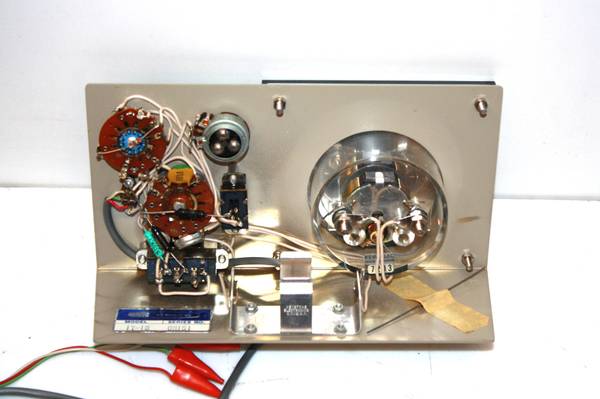
Heathkit Transistor Tester In/Out of Circuit Excellent Condition - A great device for fundamental transistor/diode testing. This is a classic mint condition vintage, In-Circuit or Out-of-Circuit Transistor Tester manufactured by the Heath Company. These are highly valued by vintage electronics hobbyists and audio repair technicians. The unit is an affordable, portable tool used to quickly evaluate bipolar junction transistors (BJTs) and diodes. It runs on a single D cell (not included). We can provide a digital copy of the manual if you bring a drive. Just using it, as I did when I built one as a young kid, helped me understand transistor fundamental behavior and characteristics. The testing procedure provides a education about the different issues that arise with transistors, that modern transistor testers avoid. I still use mine today. This unit came to me from a former engineer, who took meticulous care of his test equipment.
Cash Sale No Holds call or Text for Local Pick-up Only.
Transistor Behavior and Characteristics You Can Learn
DC Beta (Gain): The tester physically demonstrates how a small base current controls a larger collector current. By calibrating the meter, you learn how to measure a transistor’s amplification factor (β).
Leakage Current I/CEO and I/CBO: You learn that transistors aren't perfect switches. The IT-18 teaches you to read minor current leakages, helping you understand how temperature and material degradation affect solid-state components.
Polarity Identification: By switching between NPN and PNP modes to get a proper reading, you learn how current flows differently through electron-dominant (NPN) versus hole-dominant (PNP) semiconductor materials.
Practical In-Circuit Diagnostic Logic
Circuit Loading Effects: Testing a transistor while it is still soldered into a circuit board teaches you about parallel resistance and capacitance. You learn that in-circuit testers must use low voltages (the IT-18 uses a 1.5V battery) so they don't accidentally turn on surrounding diodes or semiconductor junctions, which would fake a bad reading.
Symptom-Based Troubleshooting: It trains your brain to categorize component failures into distinct electronic states: a dead short, an open circuit, or a leaky junction.
Vintage Circuit Design & Maintenance
If you open the unit up to fix or calibrate it, it serves as an excellent, simple classroom for:
Bridge Circuits: The IT-18 relies on a balance network to measure resistance and gain.
Analog Meter Ballistics: You learn how delicate 100µA d'Arsonval meter movements work and how shunt resistors are used to change the meter's measurement ranges.
Key Features/ Specifications
Measurement Capabilities: Measures DC Beta (gain) from 2 to 1,000 across two distinct ranges (2–100 and 20–1,000). It also tests for I/CEO and I/CBO leakage current up to 5 mA.
Testing Methods: Components can be tested out-of-circuit via an integrated front-panel test socket or in-circuit using attached alligator clip leads.
Visual Display: Features a large, clear 4.5-inch 100µA analog meter. The leakage scale is non-linear and expanded at the lower end, allowing you to read currents as small as 5µA.
Power Supply: Entirely portable, operating on a single 1.5V "D" cell battery. Testing utilizes low voltage, ensuring that accidental incorrect hookups won't damage sensitive solid-state components.